
Teenagers Translated – author interview with Janey Downshire

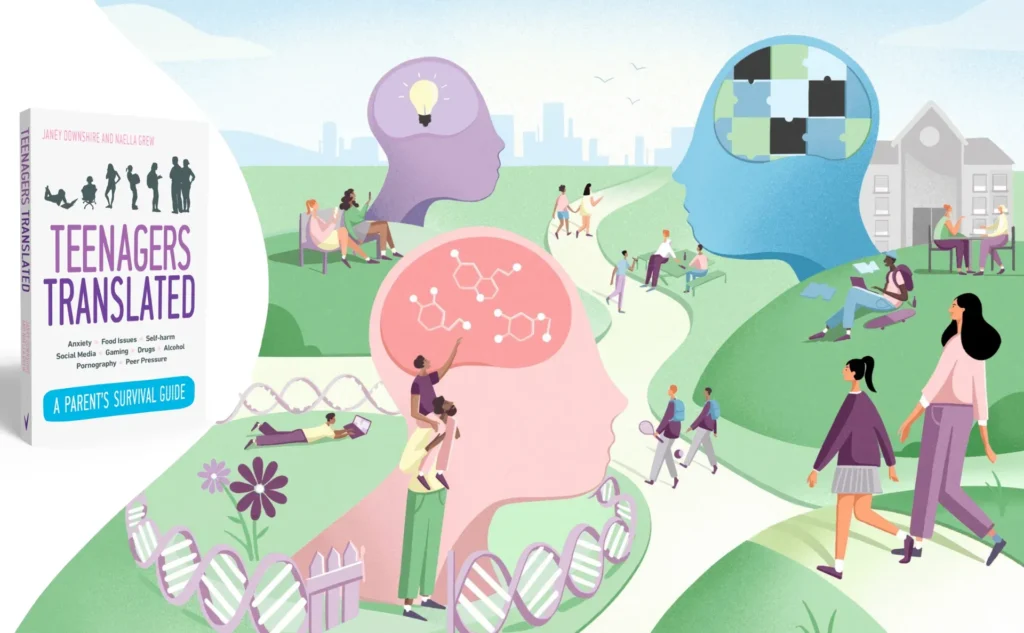
I was giving a talk at an event in Yorkshire recently when I bumped into Janey Downshire, which was a real treat. Janey is one of my heroes. She co-wrote Teenagers Translated with Naella Grew, a book I found so useful when our own children were going through their teens, and one we have been selling in our shop for a long time. It was wonderful to meet her in person, and she kindly agreed to a follow-up interview. This post is the result.
Get our lovely Healthy Bites newsletter!
Each week, you’ll get an amazing recipe, a useful health tip, and an ingredient to jazz up your shopping basket!
Interview with Janey Downshire
How did Teenagers Translated begin, and what made you and Naella turn your workshops into a book?
As friends, we both had some training in psychology and emotional literacy when our children were quite young. This knowledge and understanding meant that we found ourselves discussing different and more effective ways to approach challenges with our own teens. We had 7 between us so plenty of examples to work with, so in 2009 we decided to team up properly and we founded the Teenagers Translated programme.
Then, once we were up and running we were giving a workshop in [place], and one of the parents on it turned out to be a book agent. She encouraged us to write the book. I loved the idea that we could reach and help more people.
Teenagers Translated aims to translate normal child development, the changing teenage brain and relationship psychology into relevant, practical, doable tools for parents with their teen. Some sections of the book, e.g. on drugs, food issues and pornography are designed to be read by teenagers too, to provide them with the information they need directly.
The book says parenting a teenager can now last up to 14 years. What has changed about adolescence?
Today, children are exposed to more peer-led media content, and this exposure is shaping their developing values, attitudes and beliefs at a younger age than pre-tech generations. It is harder for parents and family to assert core values and boundaries now, between ages 10-16 because they may not fit with societal “norms”.
Teenage type behaviour (triggered by brain change) can appear at 10 and neuroplasticity continues into the mid 20s. Young adults are programmed to seek independence and autonomy, however many remain dependent or are even living with parents well into their 20s, hence the wider window.
Our book helps parents get a more nuanced understanding of relationship psychology in order to maintain a balanced parent child dynamic from early adolescence through to adulthood – it’s a long window.
If you could tell every parent one thing about the teenage brain, what would it be?
Kids have such a huge amount of brain restructuring going on from age 10+. And because the brain is the main driver behind behaviour (with emotions providing the fuel that drives that engine), parents having a better understanding of the driving emotions helps them to respond and react more appropriately to what might appear to be unacceptable behaviour, in ways that can actually help shape their child’s brain in the right way – and even their developing character.
You describe a “settled” and an “unsettled” system. Could you explain that?
These two systems are emotion-based and are a combination of fluctuating and changing:
- Biochemical body/mind states (eg. Adrenaline, Noradrenaline, GABA, Serotonin, Oxytocin, Melatonin) – when “Settled” a child might appear happy, motivated and relaxed, versus “Unsettled” when a child might look panicked, angry or anxious.
- Brain states – when “Settled”, a child is focused, engaged and learning, versus “Unsettled” when they might be distracted, zoned out or forgetful.
- Social and relational dynamics – when “Settled”, a child might be playful, communicative, and collaborative versus when “Unsettled”, they may be combative, sulky or disengaged.
Teenagers should be branching out and exploring their world, making new friends, taking risks and becoming autonomous. Encountering challenges, getting stressed and tipping into an “Unsettled” state is normal. Parents can help their teen re-align their emotional regulation dial and get back on track, through calm interactions, logical discussions and upholding secure, firm fair boundaries. Through experiencing this, a child learns how to manage their self-regulation dial – this is emotional resilience – bouncing back from adversity.
A lot of the book is about parents rather than teenagers. Why?
The book is about things that parents might find helpful to know about their teenager. When the brain is undergoing a massive overhaul ready for adulthood, this is a necessary and exciting stage of child development, and parents can help with this process in a few ways:
The brain learns and adapts through mirror neurons so if parents can role model the sorts of behaviours, interactions and reactions – particularly when in response to challenges (waiting for calm and explaining rather than just to lecture/punish) – they can have a huge influence on the adult our child becomes, it becomes a sort of blueprint relationship which a child can take forward.
Adolescence is also a time when teenagers naturally need to push boundaries and take risks, and this can be a challenging phase for parents. Knowing own core values (eg. honesty, kindness, respect) means that parents start to understand why they react very strongly to certain teen behaviours eg. lies, meanness, laziness or disrespect. Knowing own reactor buttons helps parents reduce and manage their over reactivity and to be able to have more “Adult” rational discussions around independence, boundaries and autonomy thereby having a smoother passage through the choppy waters of adolescence.
Calm is contagious, teenagers learn far more from what we do, than from what we say.
You talk about “counter-intuitive parenting”. Why should we sometimes let our children fail?
Resilience works like a muscle and needs exercise, which it does not get if parents rescue a child every time they fail, make a mistake or get into trouble. It’s the being able to bounce back from any adversity (and experience sadness, frustration or shame) that is important, not least it helps a child to learn what to avoid in the future or how to cope more effectively next time.
A parent who “helps” too much for their child is dis-ableing them, this teenager would not learn how to solve their own problems, make choices and take responsibility, and ultimately they will always rely on others and risk being subject to peer influence and following the crowd.
The ideal balance is that a child knows parents care deeply, they’re there to pick up the pieces if asked, but they empower the teenager to take charge: by letting go, and letting them make up their own mind – literally.
What is your advice for talking to a teenager who does not want to talk?
- Start by oiling wheels of discussion by asking questions and getting them to talk about things they do have views, opinions and interests in.
- Aim for shoulder-to-shoulder conversations, such as chatting in the car or while doing something they enjoy together.
- Aim to guide rather than lecture, encouraging them to reflect rather than telling them what to think/do.
- Avoid nosey or Spanish Inquisition type questioning.
- Use humour – but be careful not to embarrass, or shame in front of others (it’s a sensitive time).
- Have conversations in “Adult to Adult” mode. Give them a stake in decisions and directions.
Should parents hold boundaries when they hear “everyone else is allowed to”?
- Decide what matters in your own household, then give your reasons calmly and clearly and explain if, when and why limits will change.
- Take a proactive stance, you decide when changes happen so there’s “Flexibility without surrender”.
- Check with a few other parents to see if “everyone” really is allowed.
- Accept that holding the line may make you unpopular for a while.
- Avoid threats of punishment, then giving in. If you need to carry out consequences, make sure it fits the misdemeanour. Avoid bribes.
How can parents tell the difference between normal teenage behaviour and a real cause for concern?
Mental health is on a sliding scale, and anxiety is very often what is driving the fluctuations. Parents should expect to see emotional turmoil (because this accompanies brain overhaul). It is normal at this stage. But there should be “ups” too.
There will be stressful times, like transitions to new school, changes/loss at home or exam pressure.
Look out for any longer-term changes like social withdrawal, shifts in sleep and eating patterns, and dropping friendships or interests.
If this status doesn’t shift after several weeks, and you have checked and talked to your child, then offer to book an appointment with GP and go together.
The book covers self-harm, food issues, drugs and alcohol. What links these behaviours?
Behaviours involving needing an emotional boost, doing something to numb, using distractions or mood enhancers are often a subconscious reaction to underlying emotional dissonance.
The “problem” (drugs, food, alcohol or cutting) at this stage is not the problem, they have become “unhealthy coping strategies” and vital ways to settle dysregulated emotions.
Look at what is going on in your teen’s world that might have triggered the emotional upset, the not coping is where parents should focus firepower.
Teenagers need to develop a tool kit of “healthy” coping and de-stressing habits and lifestyle to keep their emotions & biochemicals in balance – and every teen is different.
It helps for parents to understand the dopamine reward system because this drives addictive patterns of behaviours getting established; and that’s when the problem does risk becoming more serious.
But self-harm, eating disorders or anything involving immediate safety are not things you should tackle on your own. Get help and advice straight away. The Young Minds parents’ helpline is a good place to start: 0808 802 5544.
Teenagers Translated was last updated in 2018. What has changed in the digital world since then?
Such a lot, in particular algorithms and short-form video which feeds users a never ending stream of highly engaging content, giving the (vulnerable) brain a dopamine overdose, which risks (in some teens) setting up addictive pathways at a key stage of brain development.
- So much free content and multiple platforms make it hard for parents to impose the “hour rule” – a balance of physical versus being online.
- Age inappropriate content, eg. pornography which is now free and easily accessible for younger teens to access, including via VPNs.
- A wide range of sophisticated devices.
- AI chatbots offering a new “friendship” and advice/guidance option
All of which make it even more important for parents to keep up to date with what is available, being accessed and to have lines of communication to learn and explain to their teen why they eg. ban devices from bedrooms, impose limits, not allow certain social media apps.
What do you mean by “turning up the central heating” at home?
Parents need to be aware of relationship dynamics at home and how to use non-verbal communication, body language, Emotional warmth: looking genuinely pleased to see teens, using humour, and moving on from disagreements without grudges. Home needs to remain a warm and secure safe space for teens to return to between exploring and independence.
Maintaining family routines and rituals such as shared mealtimes, looking after pets – these offer a sense of predictability and reassurance at home, when the world can feel quite challenging.
This all means they do need warmth and support for challenges and family upheavals, especially separation and divorce.
Is there anything you would write differently today?
- I would definitely write more on how things have changed post pandemic: the increase in anxiety, exam pressure & job market, the overall decline in wellbeing and resilience, although the principles for handling it remain the same.
- Since my own children, now adults with their own children, have helped shape my thinking, I do have more practical examples to weave in.
- Some science has moved on since the book was written, for example research on sex differences in the brain has been updated, so some clarifications would help.
What one thing could a parent reading this try tonight?
Try the “pebble in a pond” idea: small changes by parents can have a big impact across the family.
Round up
You can find Janey Downshire’s Teenagers Translated work with parents, schools and 1:1 coaching at teenagerstranslated.co.uk. Her highly-rated book is available on naturedoc.shop.
Responses